Bollywood History
From the 1930s, the business was generating more than 200 films per annum.
The initial Indian audio movie, Ardeshir Irani's Alam Ara (1931), was a significant business success. There was a massive marketplace for talkies and musicals; Bollywood and of the regional film industries immediately changed to audio filming.
Most Bollywood movies were escapist, but there were also quite a few filmmakers who handled tough social problems, or utilized the struggle for Indian independence as a background for their own plots.
In 1937, Ardeshir Irani, of Alam Ara fame, created the very first color film in Hindi, Kisan Kanya. The following year, he left another color movie, a variation of Mother India. But, color didn't come to be a favorite characteristic before the late 1950s. At this moment, lavish romantic musicals and melodramas have been the basic fare in the theatre.

Before the 1947 partition of India, that had been split into the Republic of India and Pakistan, the Bombay film industry (currently called Bollywood) was closely into the Lahore movie industry (currently the Lollywood sector of Pakistani theater), as equally generated movies in Hindi-Urdu, or Hindustani, the lingua franca across central and northern India. From the 1940s, several celebrities, filmmakers and artists from the Lahore sector migrated into the Bombay sector, such as celebrities like K.L. Saigal, Prithviraj Kapoor,
Dilip Kumar and Dev Anand and artists like Mohammed Rafi, Noorjahan and Shamshad Begum. Throughout that time, filmmakers and celebrities in the Bengali film industry established in Calcutta (now Kolkata) also started migrating into the Bombay film industry, which for decades following partition could be dominated by celebrities, filmmakers and musicians who have roots in what's now Pakistani Punjab, combined with people from Bengal.
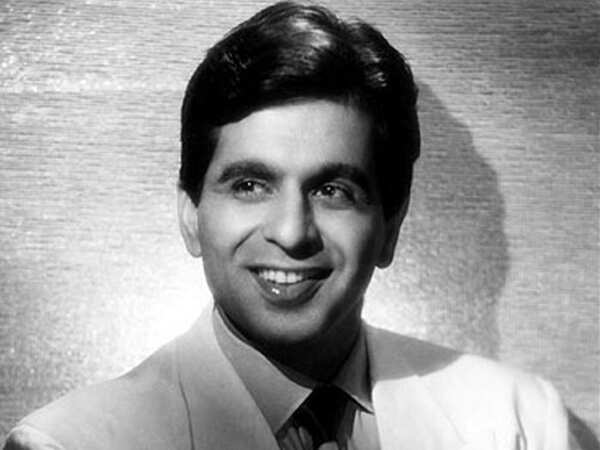
After India's independence, the interval in the late 1940s into the early 1960s is viewed by film historians as the "Golden Age" of Hindi film. One of the most critically acclaimed Hindi movies of all time have been created in this time. These pictures expressed societal topics mainly dealing with working lifetime in India, especially urban life at the prior two illustrations; Awaara introduced the town as both a nightmare and a dream, whilst Pyaasa critiqued the unreality of town life.
Mother India was also a significant movie that described the conventions of Hindi cinema for decades. Composed and created by Dilip Kumar, Gunga Jumna was a dacoit crime drama about two brothers on opposite sides of law enforcement, a motif that later became prevalent in Indian movies since the 1970s. One of the most well-known epic movies of Hindi cinema were also created at the moment, for example K. Asif's Mughal-e-Azam (1960). Other famous mainstream Hindi filmmakers in the time comprised Kamal Amrohi and Vijay Bhatt.

The three most common male Indian celebrities of the 1950s and 1960s have been Dilip Kumar, Raj Kapoor, and
Dev Anand, each with their own distinctive acting style. Kapoor followed the "tramp" design of Charlie Chaplin, Anand made himself following the "suave" design of Hollywood film stars such as Gregory Peck and Cary Grant, and Kumar initiated a kind of method acting which was comparable to nonetheless predated Hollywood strategy actors like Marlon Brando. Kumar, who had been depicted as "the greatest method actor" by Satyajit Ray and is regarded as one of India's best celebrities, motivated future generations of Indian celebrities; similar to Brando's influence on Robert De Niro and Al Pacino, Kumar had a similar effect on after Indian celebrities like
Amitabh Bachchan, Naseeruddin Shah, Shah Rukh Khan and Nawazuddin Siddiqui.

While commercial Hindi cinema was flourishing, the 1950s also saw the development of a brand new Parallel Cinema motion. Although the motion was mainly directed by Bengali cinema, in addition, it started gaining prominence in Hindi film. The motion highlighted social realism. Early examples of movies in this motion include Dharti Ke Lal (1946) led by Khwaja Ahmad Abbas and according to the Bengal famine of 1943, respectively Neecha Nagar (1946) led by Chetan Anand and composed by Khwaja Ahmad Abbas, and Bimal Roy's Do Bigha Zamin (1953). Their critical acclaim, in addition to the latter's industrial success, paved the way for Indian neorealism and the Indian New Wave. A number of the globally acclaimed Hindi filmmakers included with the motion comprised Mani Kaul, Kumar Shahani, Ketan Mehta, Govind Nihalani, Shyam Benegal and Vijaya Mehta.
In 2010. He was the first Indian actor to be Known as a "celebrity
starring in 15 successive solo hit movies from 1969 to 1971.
Ever since the social realist movie Neecha Nagar won the Grand Prize in the earliest Cannes Film Festival, Hindi movies were often in competition for the Palme d'Or in the Cannes Film Festival during the 1950s and early 1960s, using a number of those winning major prizes in the festival. Guru Dutt, while missed in his life, had belatedly generated global recognition much later from the 1980s. Dutt has become considered as one of the most significant Asian filmmakers of all time, together with the famous Indian Bengali filmmaker Satyajit Ray. The 2002 Sight & Sound critics' and supervisors' survey of greatest filmmakers rated Dutt in No. 73 on the listing. A number of his movies are now included one of the best movies of all time, together with Pyaasa (1957) being featured in Time magazine "All-TIME" 100 best films record, and together with Pyaasa and Kaagaz Ke Phool (1959) tied at No. 160 at the 2002 Sight & Sound critics' and directors' survey of all time best movies.
From the late 1960s and early 1970s, the sector had been dominated by musical love movies using "romantic hero" leads, the hottest being Rajesh Khanna.

From the beginning of the 1970s, Hindi cinema was undergoing thematic stagnation,dominated by musical love movies. The coming of screenwriter duo Salim-Javed, comprising Salim Khan and Javed Akhtar, marked a paradigm change, revitalizing the business. They started the genre of gritty, violent, and Bombay underworld crime movies in the early 1970s, together with movies like Zanjeer (1973) and Deewaar (1975). They reinterpreted the rural topics of Mehboob Khan's Mother India (1957) and Dilip Kumar's Gunga Jumna (1961) at a modern urban context representing the Profession and socio-political climate of 1970s India,channeling the rising discontent and disillusionment among the masses,and unprecedented development of slums, and addressing topics involving urban poverty, and corruption, and crime,in addition to anti-establishment themes. This led in their generation of this "angry young man", personified by Amitabh Bachchan,that reinterpreted Dilip Kumar's functionality in Gunga Jumna at a modern urban context,and giving a voice to the angst of the metropolitan poor.
From the mid-1970s, intimate confections had made way for gritty, violent crime movies and action movies about gangsters (Bombay underworld) and bandits (dacoits). The composing of Salim-Javed and behaving of Amitabh Bachchan popularized the trend, together with movies like Zanjeer and especially Deewaar, a crime movie inspired by Gunga Jumna that pitted "a policeman against his brother, a group leader predicated on real-life smuggler Haji Mastan" portrayed by Bachchan; Deewaar was portrayed as being "absolutely crucial to Indian theatre" by Danny Boyle. Together with Bachchan, additional celebrities that rode the crest of the tendency include Feroz Khan, Mithun Chakraborty, Naseeruddin Shah, Jackie Shroff, Sanjay Dutt, Anil Kapoor and Sunny Deol, that continued to the early 1990s.
The 1970s was whenever the title "Bollywood" was filmed, and whenever the strangest conventions of industrial Bollywood movies were created. Crucial to this is the development of this masala movie genre, that combines elements of numerous genres (action, humor, romance, drama, melodrama, musical). The masala movie was initiated in the early 1970s by filmmaker Nasir Hussain,and screenwriter duo Salim-Javed, sparking the Bollywood blockbuster arrangement. Yaadon Ki Baarat (1973), led by Hussain and composed by Salim-Javed, was identified as the initial masala movie and also the "initial" quintessentially "Bollywood" movie. Salim-Javed went on to compose more successful masala movies in the 1970s and 1980s. Masala movies launched Amitabh Bachchan to the largest Bollywood film star of the 1970s and 1980s. A milestone for the masala movie genre has been Amar Akbar Anthony (1977),led by Manmohan Desai and composed by Kader Khan. Manmohan Desai went to successfully harness the genre in the 1970s and 1980s.
These two tendencies, the masala movie and the violent crime movie, are represented from the blockbuster Sholay (1975), composed by Salim-Javed and starring Amitabh Bachchan. It united the dacoit movie conventions of Mother India and Gunga Jumna with that of Spaghetti Westerns, spawning the Dacoit Western genre (also called the "Curry Western"), that was widely popular from the 1970s.
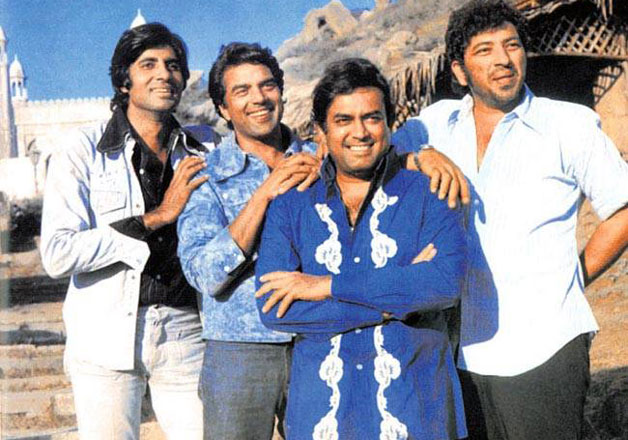
Some Hindi filmmakers like Shyam Benegal continued to create realistic Parallel Cinema through the 1970s, along with Mani Kaul, Kumar Shahani, Ketan Mehta, Govind Nihalani and Vijaya Mehta. But, the 'art movie' bent of the Film Finance Corporation came under criticism through a Committee on Public Undertakings evaluation in 1976, which accused the entire body rather than doing enough to promote commercial theatre. The 1970s thus watched the growth of commercial theatre in the shape of enduring movies like Sholay (1975), which merged Amitabh Bachchan's standing as a lead performer. The devotional classic Jai Santoshi Ma was also published in 1975.
The most globally acclaimed Hindi picture of the 1980s has been Mira Nair's Salaam Bombay!
New Bollywood (1990s--current)
From the late 1980s, Hindi theater underwent another phase of stagnation, with a drop in box office turnout, because of rising violence, decrease in musical melodic quality, and increase in movie piracy, resulting in middle-class family audiences left theaters. The turning point came with Qayamat Se Qayamat Tak (1988), led by Mansoor Khan, composed and created by his dad Nasir Hussain, also starring his cousin Aamir Khan together with Juhi Chawla. Its mix of youthfulness, healthy entertainment, psychological quotients and powerful melodies enticed family audiences back into the screen.
The span of Hindi cinema from the 1990s Onwards is known as "New Bollywood" theater, connected to economic liberalisation in India through the early 1990s. At the time period, action movies and comedy films were effective, with celebrities such as Govinda, Sunny Deol, Sunil Shetty, Akshay Kumar, and Ajay Devgan, together with Akshay Kumar gaining popularity for performing hazardous stunts in action movies in his famous Khiladi (movie series) along with other action movies.

This decade also marked the entrance of new actors in Art house and independent films, some of which succeeded commercially, the strongest illustration being Satya, directed by Ram Gopal Varma and composed by Anurag Kashyap. The commercial and critical success of Satya resulted in the development of another genre called Mumbai noir,urban movies representing societal issues in the city of Mumbai. This Resulted in a resurgence of Parallel Cinema at the end of the decade. These pictures often featured celebrities such as Nana Patekar and Manoj Bajpai, and actresses such as Manisha Koirala, Tabu, Pooja Bhatt and Urmila Matondkar, whose performances have been generally critically acclaimed.
Aamir Khan
Among those "Three Khans", in 2008. He's become the very successful Indian performer since the late 2000s.
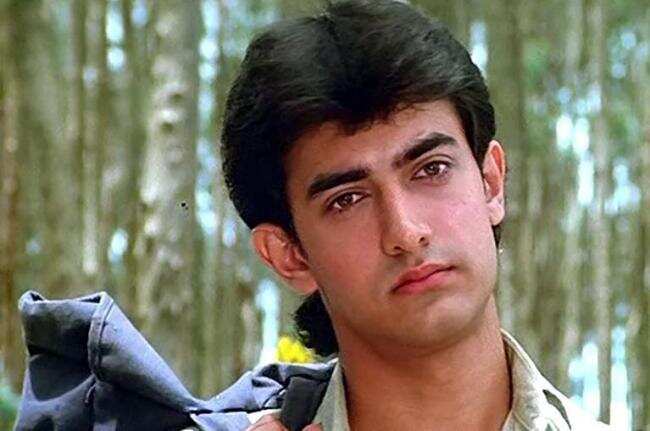
Combined, they've starred at the top ten highest-grossing Bollywood movies. Both Khans have had successful careers since the late 1980s,and have mastered the Indian box office as the 1990s, over three years. Shah Rukh Khan has been the very successful Indian celebrity for most of the 1990s and 2000s, while Aamir Khan was the strongest Indian celebrity since the late 2000s; in accordance with Forbes, Aamir Khan is "arguably the world's biggest film star" at 2017, because of his immense fame in the planet's two most populous countries, India and China.
The 2000s saw a rise in Bollywood's fame throughout the world because of a growing and booming NRI and Desi communities abroad. A quick increase in the Indian market and a requirement for quality entertainment in this age, led the country's film-making to brand new heights concerning production values, cinematography and innovative story lines in addition to technological advances in areas like special effects and animation. A number of the greatest production houses, one of them Yash Raj Movies and Dharma Productions were the manufacturers of fresh contemporary movies.

From the 2010s, the sector saw the tendency of established film stars such as
Salman Khan, Akshay Kumar and
Shahrukh Khan manufacturing big-budget masala entertainers such as Dabangg (2010), Ek Tha Tiger (2012), Rowdy Rathore (2012), Chennai Express (2013), Kick (2014) and Happy New Year (2014) reverse considerably younger actresses. These pictures were frequently not the topic of critical acclaim, but were nevertheless important commercial successes. On the flip side, Aamir Khan was imputed for redefining and modernizing the masala movie (which originated out of his uncle Nasir Hussain's Yaadon Ki Baarat, which he appeared in) together with his own distinct brand of socially conscious cinema from the early 21st century, making both commercial success and critical acclaim.

While many celebrities in the 2000s continued their successful careers to the next decade, the 2010s also saw the growth of a new production of popular actors such as Ranbir Kapoor, Ranveer Singh, Varun Dhawan, Sidharth Malhotra, Sushant Singh Rajput, Arjun Kapoor, Aditya Roy Kapur and Tiger Shroff, in Addition to actresses such as Vidya Balan, Kangana Ranaut, Deepika Padukone, Sonam Kapoor, Anushka Sharma, Sonakshi Sinha, Jacqueline Fernandez, Shraddha Kapoor and Alia Bhatt, together with Balan and Ranaut gaining broad recognition for effective female-centric movies like the Dirty Picture (2011), Kahaani (2012) and Queen (2014), along with Tanu Weds Manu Returns (2015). Kareena Kapoor and Bipasha Basu are amongst the few operating actresses in the 2000s who successfully completed 15 years in the business.

Was the useful?