History Of Nokia
Nokia is a Finnish multinational corporation based on the 12 May 1865 as one paper mill operation. Throughout the 19th century that the firm expanded, branching into a number of diverse products. In 1967, the Nokia company has been formed. In the late 20th century, the business took advantage of the rising popularity of computer and mobile phones. However, increased competition and other market forces caused changes in Nokia's business structures. However, using Nokia branding and Nokia's licensed technology persists.
 19th century
The title "Nokia" is derived from the city, Nokia and the Nokianvirta river. The industrial entities which preceded the modern day Nokia company comprised Nokia Ab (Nokia firm); Suomen Gummitehdas Oy (Finnish Rubber Works Ltd); and Suomen Kaapelitehdas Oy (Finnish Cable Works Ltd).

In 1865, the mining engineer, Fredrik Idestam established a floor wood pulp mill on the banks of the Tammerkoski rapids in the town of Tampere, in southwestern Finland. Tampere was subsequently part of the Russian Empire. In 1868, Idestam built another mill near the town of Nokia. Nokia is located 15 kilometres (9.3 mi) west of Tampere, by the Nokianvirta river. The river had improved hydropower resources than those at Tampere. In 1871, Idestam and Leo Mechelin, a statesman and Idestam's buddy, transformed Idestam's ventures to a public limited company called Nokia Ab.
From the late 1800s, Mechelin wished to expand the business to the electricity business. But, Idestam refused. In 1896, Idestam retired and Mechelin become the corporation's chairman. In this time period, Mechelin persuaded shareholders to enable the company to enter the power business.In 1902, Nokia commenced electricity production.
20th century
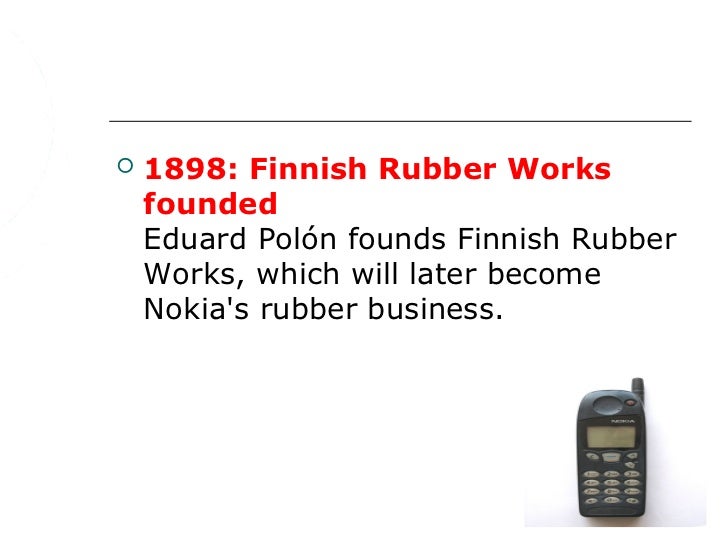 Eduard Polón (1861 -- 1930), was a Finnish business leader.In 1898
, Polón based Suomen Gummitehdas Oy (Finnish Rubber Works) - a producer of galoshes and other rubber products.In the early 1900s, the Finnish Rubber Works established factories near Nokia and used the city's name in the provider's branding.
Following World War I, the Nokia Business was nearing bankruptcy and was acquired by the Finnish Rubber Works.
In 1922, the Finnish Rubber Works also obtained the Suomen Kaapelitehdas Oy (Finnish Cable Works). The cable works were set up in 1912 by Arvid Wickström. His company produced telephone, telegraph, and electric cables.
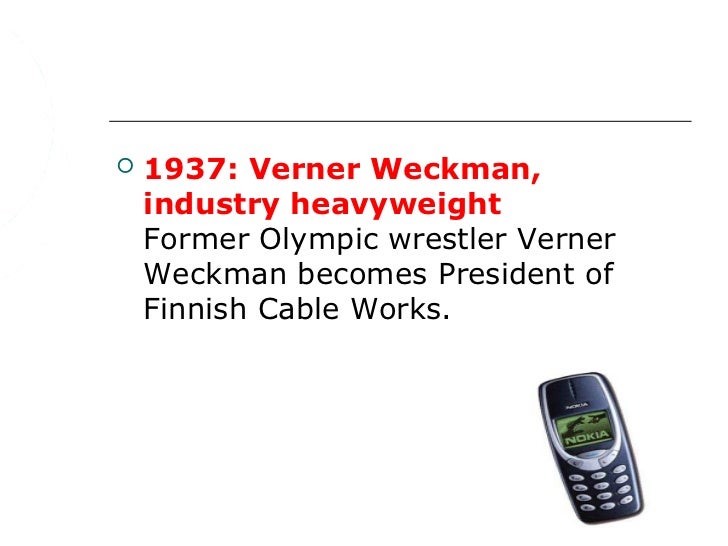
In 1937, after 16 years as a technical manager, Verner Weckman became the president of the Finnish Cable Works business. Following World War II, Finnish Cable Works provided cables into the Soviet Union as part of its war reparations. This gave the company a foothold for after commerce.
Though the three firms, (Nokia Ab, Suomen Gummitehdas, and Suomen Kaapelitehdas) weren't merged in the legal sense, Polón made a viable group. Polón was the chairman, managing director, and the largest share holder of this group for 30 years.
Nokia corporation
A capacitor produced by Nokia Capacitors
In 1967, Nokia Corporation was formed through the merger of the three firms. The new firm manufactured products such as paper products, car and bicycle tires, rubber boots, communications cables, televisions and other consumer electronics, personal computers, generators, robotics,capacitors, Military technology and equipment (like the SANLA M/90 apparatus and the M61 gas mask to the Finnish Army), plastics, aluminum and compounds.

In 1960, a cable branch of the Nokia group was formed. In 1962, it generated a pulse height analyzer used in nuclear power plants. In 1967, a digital division within the Nokia corporation has been formed. It functioned for another fifteen years, sometimes at a loss. Nokia researchers were invited to create their own projects. This might have led to Nokia's focus on cell phone technologies.
Network equipment
From the 1970s, Nokia made the Nokia DX 200, a digital switch for telephone exchanges. Its architecture let it be further developed into other switching solutions. By way of instance, in 1984, the evolution of a market for the Nordic Mobile Telephony system was started. In 1987, the country sold its shares in Telefenno to Nokia and in 1992, the name was changed to Nokia Telecommunications.
In 1998, the Israeli multinational firm, Check Point that was founded in 1993, established a partnership with Nokia.
Mobile radio telephony
Prior to mobile mobile telephony, there was cellular radio telephony. From the 1960s, Nokia had begun producing military and commercial mobile radio telephones. By 1964, Nokia had developed VHF radios in cooperation with Salora Oy. By 1966, Nokia and Salora had developed ARPs (Autoradiopuhelin or radio car phones). In 1971, this technology became the first commercially available cell phone network in Finland and in 1978, it provided 100 percent protection in Finland. In the 1970s and 1980s, Nokia developed the Sanomalaitejärjestelmä (messaging system), a digital, mobile and encrypted text-based communications device to the Finnish Defence Forces.

Nordic mobile phone (1G)
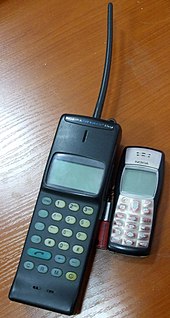
The Mobira Cityman 150, Nokia's NMT-900 cell phone from 1989 (left), in comparison with the Nokia 1100 , a GSM phone from 2003.
Mobira developed cellular phones for the Nordic Mobile Telephone (NMT) system, called the "1G" and was the first completely automatic mobile phone system.
In 1984, Nokia bought Salora. In the same year, the "Mobira Talkman", an ancient mobile phone was launched. In 1987, Nokia introduced its first cell phone, the "Mobira Cityman 900" for NMT-- 900 networks. Compared to the NMT -- 450 network, there was a superior signal strength but less policy. While the Mobira Senator of 1982 had weighed 9.8 kg (22 lb) and the Talkman just under 5 kg (11 lb), the Mobira Cityman weighed just 800 g (28 oz) including its battery. The telephone, which was considered expensive, became a thing suggesting a high status.
In 1987, the Soviet leader Mikhail Gorbachev was spotted with a Mobira Cityman in Helsinki. The telephone developed the nickname, the "Gorba".
Nokia contributed to the growth of the GSM 2G.It managed to transmit data (computing) and voice traffic. Nordic Mobile Telephony (NMT) was an early provider of worldwide roaming. In 1987, GSM 2G became the new European standard for digital cellular technology.
On 1 July 1991, in Helsinki, the first phone call on the GSM G2 system was created by Harri Holkeri, the Prime Minister of Finland. The version number, "1011" identifies its launch date on 10 November 1992.
The GSM 2G system and cellular phones provided enhanced voice calls, international roaming and support for new services like text messaging (Short Message Service (SMS)). In 2008, the GSM 2G network had roughly 3 billion users. There were 700 cell phone commercial suppliers in 218 nations or lands. There were 15 cell phone connections per second and 1.3 million mobile phone connections each day.
Personal computers
The Nokia Booklet 3G miniature laptop.
In the 1980s, Nokia's computer division "Nokia Data" generated a series of personal computers called the "MikroMikko". It had been aimed at the business market. In 1991, Nokia Data was sold to a British firm, International Computers Limited (ICL).
Nokia produced Cathode ray tubes (CRT) and thin film transistor liquid crystal displays (|TFT LCDs) for personal computers and other programs. In 2000, Nokia sold its screen products division to ViewSonic.However, in August 2009, Nokia introduced the Nokia Booklet 3G miniature laptop which it lasted for a brief time.Other abandoned Nokia products include DSL modems and electronic set-top boxes.
Telecommunications

In the 1980s under the chief executive officer (CEO) Kari Kairamo, Nokia enlarged, largely through acquisitions. Losses were produced from the television production division.In 1988, Nokian Tyres became a distinct entity. In 1990, Nokian Footwear was a distinct entity. During the remainder of the 1990s, Nokia divested itself of the other businesses.
After his passing, Simo Vuorilehto became Nokia's chairman and CEO. Vuorilehto made major modifications to the Nokia business. The television and private computing divisions were sold.
In 1992, Jorma Ollila became CEO. He made telecommunications Nokia's only concern.International earnings increased relative to those in Finland. From the mid 1990s, Nokia's source of cellular telephones couldn't meet demand.Changes into Nokia's supply chain were made.Between 1996 and 2001, Nokia's earnings increased from 6.5 billion euros to 31 billion euros and between 1998 and 2012, Nokia was the world's biggest mobile phone manufacturer. Nokia's logistics and economies of scale advantaged the provider.
21st century
Reduction in proportion of Nokia mobile phones. Left to right: Nokia 638 (1996; 19.06 cm height), Nokia 2160 EFR (1996; 16.42 cm), Nokia 5160 (1998; 14.84 cm), Nokia 6070 (2006; 10.5 cm)
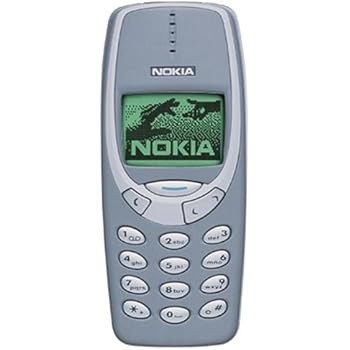
In 2000, Nokia launched the Nokia 3310. In 2003, the Nokia 1100 handset was launched. Nokia combined a video game console and a cell phone at the "N-Gage".
In April 2008, Nokia Productions began a cellular movie-making project. The movie that was presented at the Nokia Theater Los Angeles on 14 October 2008 has been directed by Spike Lee. It was approximately 15 minutes long and included short segments made on mobiles contributed by the general public. The topic of the film was "humanity".
In 2009, Nokia reentered the personal computing industry. Its product, the Nokia Booklet 3G was a Windows-based netbook. The business also entered the smartphone industry. The Series 40 was a telephone platform used in feature phones, mainly running Java-based applications. [not in citation given]
Nokia obtained Smarterphone, a firm making the Smarterphone OS for "low end" phones and merged it with Series 40 to form the Asha Platform, which also utilized a few user interface characteristics from Nokia's MeeGo platform. [citation needed] The Asha 501 utilized this new operating system. The Series 40 was stopped in late 2014.
Thank You for reading


